
₨180,600.00
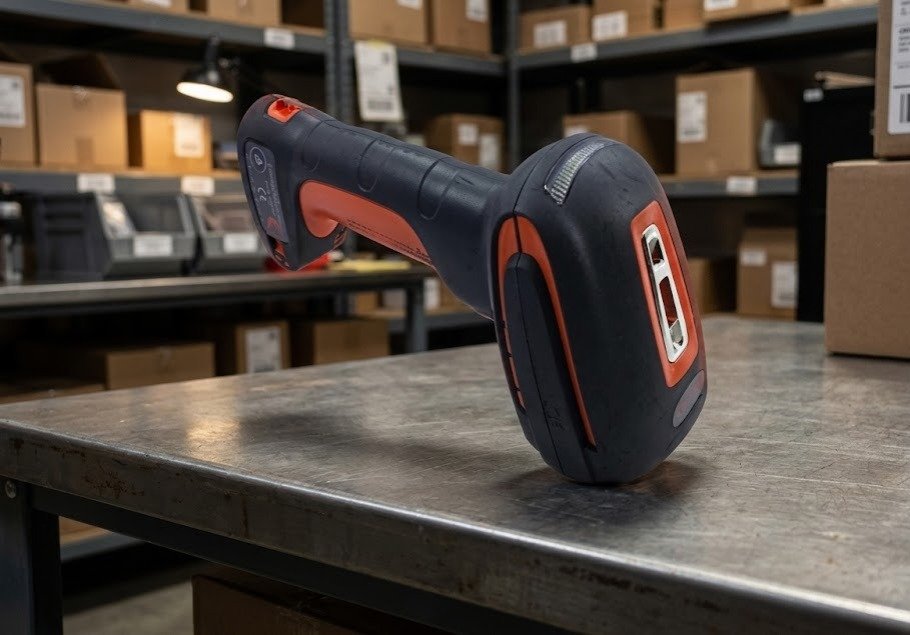
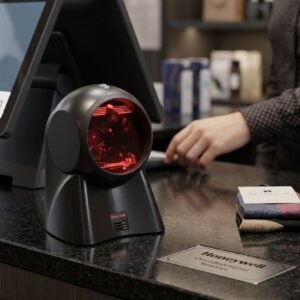
The Honeywell Granit 1980i is a corded, industrial-grade barcode scanner designed for warehouses, distribution centres, manufacturing facilities, cold-storage operations and forklift-mounted workstations.
It uses full-range area-imaging technology to read supported 1D and 2D barcodes across exceptionally wide distances. Honeywell designed it to capture high-density 2 mil codes at close range and large 100 mil warehouse codes from as far as approximately 16 metres under suitable conditions.
The scanner combines a laser-spot aimer, automatic illumination, omnidirectional decoding and barcode-centering functions to help workers target labels positioned on products, shelves, pallets and warehouse racks.
The Honeywell Granit 1980i is no longer a current-production scanner.
Honeywell lists the following lifecycle dates:
| Lifecycle stage | Honeywell date |
|---|---|
| End of life | May 2023 |
| Last contract or renewal date | May 2023 |
| End of service | May 2026 |
| Official replacement | Honeywell Granit XP 1990iXLR |
As of July 2026, the official Honeywell service period has ended. Remaining units may still be available as old stock, open-box, refurbished or used equipment, but buyers should not assume that Honeywell repair services or a new factory warranty remain available.
Check the product condition, cable, scanning performance, local warranty and return policy with GS Systemz before ordering.
The Honeywell Granit 1980i is designed for operations that need to scan both close-range item labels and long-range pallet or rack labels with one device.
A warehouse employee can use the same scanner for:
Honeywell lists reading capability from high-density 2 mil codes at close range to 100 mil Code 39 labels at distances reaching approximately 16 metres. This range can reduce the need to maintain separate close-range and long-range scanners at the same workstation.
The scanner is also built for demanding environments. It is rated IP65 and engineered to survive 50 drops from 2 metres onto concrete, including testing at temperatures as low as -30°C. Honeywell additionally lists resistance to 5,000 tumbles from 1 metre.
Key features include:
The exact cable, interface and accessories depend on the product kit supplied.
| Application | Suitability |
|---|---|
| Warehouse inventory | Excellent |
| Pallet-label scanning | Excellent |
| High-rack barcode scanning | Excellent |
| Forklift workstation scanning | Excellent |
| Distribution centres | Excellent |
| Product receiving | Excellent |
| Shipping and dispatch | Excellent |
| Manufacturing workstations | Excellent |
| Cold-storage scanning | Excellent |
| Carton verification | Excellent |
| Small high-density labels | Excellent |
| QR-code scanning | Supported |
| Data Matrix scanning | Excellent |
| PDF417 scanning | Supported |
| Fixed packing station | Excellent |
| Retail checkout | Technically possible but oversized |
| Wireless aisle scanning | Not supported |
| Direct part marks | Test first or choose a DPM scanner |
| Outdoor use in heavy rain | Limited despite IP65 |
| Hazardous-area use | Requires a separately certified scanner |
Honeywell specifically designed the Granit 1980i for warehouses, distribution centres and forklift-based workflows requiring both close-range and extended-range scanning.
| Specification | Detail |
|---|---|
| Official product name | Honeywell Granit 1980i |
| Product category | Industrial rugged barcode scanner |
| Connection type | Corded |
| Scanning technology | Full-range area imager |
| Decode capability | Supported 1D and 2D barcodes |
| Minimum resolution | 2 mil for supported 1D and 2D codes |
| Horizontal scan angle | 12.9° |
| Vertical scan angle | 8° |
| Pitch tolerance | 70° |
| Skew tolerance | 80° |
| Minimum 1D contrast | 30% reflectance difference |
| Minimum 2D contrast | 40% reflectance difference |
| Host interfaces | USB and true RS-232 |
| Input voltage | 4.0–5.5V DC |
| Operating power | 2.35W or 470mA at 5V |
| Standby power | 0.5W or 100mA at 5V |
| Dimensions | 133 × 75 × 195mm |
| Weight | Approximately 335g |
| Operating temperature | -30°C to 50°C |
| Storage temperature | -40°C to 70°C |
| Operating humidity | 0%–95%, non-condensing |
| Drop resistance | 50 drops from 2m onto concrete at -30°C |
| Tumble resistance | 5,000 tumbles from 1m |
| Environmental sealing | IP65 |
| Ambient-light tolerance | Up to 100,000 lux |
| Electrostatic discharge | ±20kV air and ±8kV contact |
| Original factory warranty | Three years |
| Current lifecycle | End of service |
| Official replacement | Granit XP 1990iXLR |
These figures come from Honeywell’s official Granit 1980i datasheet. Real scanning distances can be affected by label quality, barcode size, contrast, printing method and environmental conditions.
Full-range area imaging means the scanner can capture supported barcodes across a much wider distance range than an ordinary retail or standard-range warehouse scanner.
The Honeywell Granit 1980i can read:
Because it captures an image of the complete barcode, it can read compatible linear and two-dimensional symbols from different orientations.
This is different from a long-range laser scanner that may only read 1D linear barcodes. The Granit 1980i combines extended range with 2D capability.
The Granit 1980i supports standard linear and two-dimensional barcode families.
Common 1D applications include:
Common 2D applications include:
Honeywell’s Xenon and Granit programming guide includes QR Code, Data Matrix, PDF417, MicroPDF417 and other 2D formats among the supported configurable symbologies. The exact formats enabled on an individual scanner depend on its configuration.
Yes. The Granit 1980i is a 2D area-imaging scanner and supports QR-code decoding through its configurable symbology system.
QR-code uses may include:
Honeywell’s 1980i datasheet does not publish a specific QR-code range table. QR performance therefore depends on the QR code’s module size, printing quality, contrast and configuration.
A physical scan test is recommended when long-range QR scanning is a primary requirement.
Yes. Data Matrix is a supported 2D barcode family, and Honeywell publishes detailed Data Matrix working ranges for the Granit 1980i.
| Data Matrix size | Typical scanning range |
|---|---|
| 7.5 mil | 10–75.9cm |
| 10 mil | 10–102.3cm |
| 55 mil | 42.8–591.3cm |
| 100 mil | 80.7–1,032.5cm |
A 100 mil Data Matrix code can therefore be read from approximately 10.3 metres under Honeywell’s test conditions.
Actual results may be affected by:
Honeywell publishes the following typical reading distances:
| Barcode density | Typical range |
|---|---|
| 7.5 mil | 10–164.9cm |
| 10 mil | 10–216cm |
| 20 mil | 15.2–434.5cm |
| 40 mil | 36.4–989.1cm |
| 55 mil | 52.2–1,322.4cm |
| 100 mil | 103.4–1,600cm |
| Barcode type | Typical range |
|---|---|
| 13 mil EAN/UPC | 12.2–229.8cm |
| 7.5 mil Data Matrix | 10–75.9cm |
| 10 mil Data Matrix | 10–102.3cm |
| 55 mil Data Matrix | 42.8–591.3cm |
| 100 mil Data Matrix | 80.7–1,032.5cm |
The maximum published range is approximately 16 metres for a large 100 mil Code 39 barcode. These are typical figures rather than guaranteed distances.
Yes. Honeywell lists a minimum resolution of 2 mil for supported 1D and 2D barcodes.
This makes the scanner suitable for selected small labels used on:
Small-code performance requires:
Honeywell specifically promotes the 1980i’s ability to read poor-quality 2 mil codes at close range.
Yes. Forklift-based scanning is one of the main workflows Honeywell highlights for the Granit 1980i.
Its extended range allows an operator to remain seated while targeting compatible labels on:
The integrated laser-spot aimer and centering function help the worker select the required barcode when several labels appear in the same direction.
Practical range may be reduced by label size, rack angle, poor printing, dust, direct sunlight and vehicle vibration.
The Granit 1980i uses a laser-spot aiming system to indicate where the scanner is targeting.
This is particularly important at extended distances because a warehouse worker may be aiming at several labels placed close together on racks or pallets.
The aimer helps the operator:
The scanner still uses area-imaging technology to capture and decode the barcode. The laser spot is an aiming aid rather than a single-line laser-scanning engine.
Barcode centering restricts decoding to a selected part of the scanner’s imaging field.
Without centering, an area imager may detect more than one barcode when several labels appear within view. Centering helps the scanner transmit the code closest to the aiming point.
This can be useful for:
Honeywell identifies centering as one of the features that helps remove uncertainty during extended-range scanning.
The Granit 1980i can read some poor-quality or damaged codes when enough barcode data remains visible.
Honeywell specifically states that it can scan poor-quality 2 mil codes at close range. Its area-imaging system can also provide better flexibility than a basic single-line laser scanner when a label is wrinkled, faded or presented at an angle.
Scanning may still fail when:
Critical shipping, pallet and inventory labels should be replaced when they are severely damaged.
Honeywell lists separate minimum contrast levels for 1D and 2D codes:
| Barcode category | Minimum reflectance difference |
|---|---|
| 1D barcodes | 30% |
| 2D barcodes | 40% |
Print contrast measures the difference between dark barcode elements and their lighter background.
A barcode may be difficult to scan when:
Clear black-on-white warehouse labels normally provide the most dependable results.
The Granit 1980i was designed for harsh industrial environments rather than ordinary office or retail-counter use.
Honeywell lists:
These specifications make the scanner suitable for warehouses, loading areas, manufacturing floors and cold environments where ordinary general-purpose scanners may fail more quickly.
The Honeywell Granit 1980i has an IP65 ingress-protection rating.
The first digit, 6, indicates a dust-tight enclosure.
The second digit, 5, indicates protection against water jets under the conditions defined by the IP test standard.
IP65 does not mean the scanner should be:
The scanner and interface connection should be inspected regularly to maintain environmental protection.
Yes. Honeywell lists an operating range from -30°C to 50°C.
The scanner’s drop testing was also performed at temperatures as low as -30°C, making it more suitable for cold warehouses than many standard commercial barcode scanners.
Cold-environment precautions include:
IP65 protection does not eliminate the risk of moisture condensation inside damaged equipment.
Honeywell offered an industrial-grade cable option for the Granit 1980i.
The official datasheet states that this cable was tested for:
This cable option is designed for forklift, warehouse and industrial installations where an ordinary scanner cable may be bent, pulled or exposed to cold conditions repeatedly.
The industrial cable is an option and may not be included with every scanner kit. Verify the cable type before ordering.
The Granit 1980i supports:
The exact connection depends on the interface cable and product kit.
USB is commonly used with:
A compatible USB configuration may transmit barcode data as keyboard input or through a supported software interface.
True RS-232 can be used with:
A serial installation may require:
Confirm whether the GS Systemz package is a USB kit, serial kit or scanner-only unit.
No. The Granit 1980i is a corded industrial scanner.
It receives power and sends barcode data through its attached USB or RS-232 connection. It does not contain a rechargeable battery or Bluetooth radio.
A corded scanner is suitable when:
The Granit 1981i was the cordless model from the same generation, but its lifecycle also reached end of service in May 2026. Honeywell lists the Granit 1991iXLR as its replacement.
The 1980i is an area-imaging scanner, so it may decode compatible 1D and 2D symbols displayed on suitable digital screens.
However, Honeywell’s official 1980i datasheet focuses on printed industrial, pallet, carton and warehouse labels rather than smartphone applications. Screen scanning should therefore be tested with the exact:
A retail or modern general-purpose scanner may provide a more suitable design when smartphone scanning is the main requirement.
The Granit 1980i is positioned as a full-range industrial label scanner, not as a specialist direct-part-mark scanner.
Some clear, high-contrast marks may be readable, but buyers should not assume reliable performance on:
Test the exact direct part mark before purchasing. A purpose-built DPM scanner is normally a safer choice when direct marks are the primary application.
The scanner can transmit decoded barcode data to compatible warehouse, ERP, inventory, shipping and manufacturing applications through USB or RS-232.
Compatibility depends on:
Honeywell’s programming system allows supported barcode symbologies and data-output behaviour to be configured for different applications.
Test the scanner with the actual WMS, ERP or inventory platform before purchasing multiple units.
Yes. Honeywell lists the Granit 1980i as an end-of-life and now end-of-service product.
It reached end of life in May 2023. The last listed contract date was also May 2023, and official service ended in May 2026. The Granit XP 1990iXLR is Honeywell’s recommended replacement.
Because the end-of-service date has passed, buyers should verify:
Honeywell’s original datasheet listed a three-year factory warranty for the Granit 1980i.
That historical warranty does not mean remaining units automatically include a new three-year Honeywell warranty. The product reached end of service in May 2026.
GS Systemz should clearly state:
Do not advertise a current three-year factory warranty unless coverage has been verified for the exact serial number.
| Requirement | Recommendation |
|---|---|
| Close-range 1D scanning | Supported |
| Close-range 2D scanning | Supported |
| QR-code scanning | Supported |
| Data Matrix scanning | Supported |
| Pallet-label scanning | Excellent |
| Rack-label scanning | Excellent |
| Maximum published range | Up to approximately 16m |
| Small 2 mil codes | Supported under suitable conditions |
| Forklift workstation | Excellent |
| Cold-storage operation | Down to -30°C |
| Dusty warehouse | IP65 protection |
| USB connection | Supported |
| True RS-232 | Supported |
| Wireless operation | Not supported |
| Current Honeywell support | Ended May 2026 |
| New long-term deployment | Choose Granit XP 1990iXLR |
| Direct part marks | Choose or test a DPM model |
| Hazardous locations | Requires certified equipment |
The 1980i is most appropriate as a replacement for an existing installation or when verified remaining stock offers a clear cost advantage.
The Granit 1980i is corded, while the Granit 1981i is the wireless model from the same product generation.
| Feature | Granit 1980i | Granit 1981i |
|---|---|---|
| Scan technology | Full-range area imaging | Full-range area imaging |
| 1D and 2D scanning | Supported | Supported |
| QR-code scanning | Supported | Supported |
| Main connection | USB or RS-232 cable | Cordless communication system |
| Battery | Not required | Required |
| Charging base | Not required | Required |
| Mobility | Limited by cable | Greater warehouse movement |
| Forklift use | Excellent when tethered | Suitable for cordless workflows |
| Current lifecycle | End of service | End of service |
| Official replacement | Granit 1990iXLR | Granit 1991iXLR |
Choose the 1980i when continuous power and a secure tethered connection are required.
Choose a current cordless industrial scanner when workers need to move freely between pallets or aisles. Honeywell lists both legacy models as end of service from May 2026.
The Granit XP 1990iXLR is Honeywell’s official replacement for the Granit 1980i.
| Feature | Granit 1980i | Granit XP 1990iXLR |
|---|---|---|
| Product generation | Legacy Granit | Current Granit XP |
| Lifecycle | End of service | Current replacement |
| Connection | Corded | Corded |
| Decode capability | 1D and 2D | 1D and 2D |
| 100 mil maximum range | Approximately 16m | Up to approximately 24m |
| UPC range | Approximately 2.3m for 13 mil UPC | Up to approximately 2m published |
| Image system | Full-range imager | Separate near and far imaging arrays |
| Drop resistance | 2m | Up to 3m under listed tests |
| Tumble resistance | 5,000 at 1m | 7,000 at 1m |
| Environmental protection | IP65 | IP65 and IP67 |
| Motion tolerance | Not listed in legacy datasheet | Up to 4,500mm/s |
| Manufacturer support | Service ended | Current-generation support |
| Best purchase | Existing-system replacement | New industrial deployment |
The Granit XP 1990iXLR uses separate near and far imaging arrays, scans 100 mil codes from up to approximately 24 metres and improves durability to as many as 7,000 one-metre tumbles and selected three-metre drop tests.
Choose the 1980i when compatibility with an existing installation or verified replacement stock is important.
Choose the 1990iXLR for a new long-term warehouse deployment.
| Feature | Granit 1980i | General retail scanner |
|---|---|---|
| Main environment | Warehouse and manufacturing | Checkout and office |
| Maximum scanning range | Up to approximately 16m | Usually short or medium range |
| Drop resistance | 2m industrial testing | Commonly 1–1.8m |
| Tumble resistance | 5,000 tumbles | Usually lower |
| IP protection | IP65 | Commonly IP40–IP52 |
| Cold operation | Down to -30°C | Often around 0°C |
| Weight | Approximately 335g | Usually lighter |
| Pallet scanning | Excellent | Limited |
| Smartphone scanning | Secondary use | Common primary feature |
| Best use | Harsh industrial workflows | Indoor customer-facing use |
The Granit 1980i is more suitable for loading bays, forklifts, pallets and rack labels than for ordinary checkout scanning.
GS Systemz can help businesses in Pakistan evaluate remaining Honeywell Granit 1980i stock for warehouses, factories and distribution centres.
This product page helps buyers check:
Before placing an order, confirm:
These checks are essential because Honeywell support for the 1980i ended in May 2026.
Recommended care includes:
Correct cable selection, label design and scanner configuration are important for dependable long-range performance.
The Granit 1980i may be suitable for:
A company creating a new long-term warehouse installation should normally compare the current Honeywell Granit XP 1990iXLR before purchasing a discontinued 1980i.
Check availability of the Honeywell Granit 1980i Industrial Rugged 2D Barcode Scanner with GS Systemz in Pakistan.
Use it for close-range product codes, Data Matrix labels, QR codes, cartons, pallets and high-rack warehouse labels. Its full-range imaging, IP65 housing, cold-temperature operation and industrial drop resistance make it suitable for demanding warehouse environments.
Confirm the scanner’s condition, interface cable, industrial cable option, local warranty, repair support and complete package contents before ordering this end-of-service model.
The Honeywell Granit 1980i is a corded industrial full-range area-imaging scanner designed to read supported 1D and 2D barcodes in warehouses and distribution centres.
Yes. QR Code is included among the configurable 2D symbologies supported by Honeywell’s Xenon and Granit scanner platform.
Honeywell lists a typical maximum distance of approximately 16 metres for a large 100 mil Code 39 barcode.
Yes. Honeywell lists a minimum resolution of 2 mil for supported 1D and 2D codes under suitable conditions.
No. It is a corded scanner supporting USB and true RS-232 interfaces.
Yes. Honeywell lists an operating range from -30°C to 50°C and tested its two-metre drop resistance at -30°C.
The scanner has an IP65 rating, providing dust-tight construction and tested protection against water jets.
It is engineered for 50 drops from two metres and 5,000 tumbles from one metre under Honeywell’s stated testing conditions.
Yes. It reached end of life in May 2023 and end of service in May 2026. Honeywell lists the Granit XP 1990iXLR as its replacement.
You can check remaining Honeywell Granit 1980i availability with GS Systemz in Pakistan. Confirm whether the unit is new, open-box, refurbished or used before ordering.
Reviews
There are no reviews yet.